Following the August 4th blast in Beirut port, it was estimated that 44,000 residential units were
affected by the blast with various damages, but what was common among all these units is the
shattered glass from windows and sliding doors. The shattered glass estimate was around 5000
tons.
Three days after the blast, a consortium of civil society consisting of Mouwaten Lebneneh, Baytna Baytak, Minteshreen and Embrace reached out to me to help devise a plan to clean up the areas of Gemmayzeh and Mar Mikhael. The plan consisted of collecting as much of the shattered glass and sending it to the Beddaoui area north of Tripoli where 2 industrial glass making factories are in operation (combined daily capacity 19,000 Kgs of glass) and to Sarafand glassblowers, which is an artisanal glassblowing workshop (daily capacity 150 Kgs of glass).
The first obstacles were financial; the combined group of NGO’s had enough money to cover the collection process from houses in the affected areas but no budget to cover the loading and transportation costs to the North and South facilities. I took it upon myself to secure the funding for that part of the operation.
The second obstacle was technical. Upon dispatching the rubble to the factories, the first loads of collected glass contained too much debris (gravel, wood and other impurities) and they pointed out that they could not introduce them as presented in their ovens. An inspection step was necessary to precede the feeding into the ovens. This step required two operators at each factory; hence, four workers to be remunerated monthly, a cost the factories were not able to incur at that moment. I told both factories to secure the workers and that I will find money to compensate the inspection costs.
Once the obstacles were surmounted by securing Bank Audi’s support, the plan evolved:
1- The civil society groups mentioned above with the help of volunteers secured three pickups to do the rounds over the totality of the affected areas, stretching from Beirut Port neighborhoods all the way up to Hazmieh. A whatsapp hotline was installed to which citizens were asked to send their locations so collection teams/trucks can collect the shattered glass.
2- I secured a bobcat and two pickup trucks to load the collected glass from the Mar Mikhael train station which was used as a glass storage space for the needs of this operation. All pickups where weighed using an electronic scale operator by Beirut Forum.
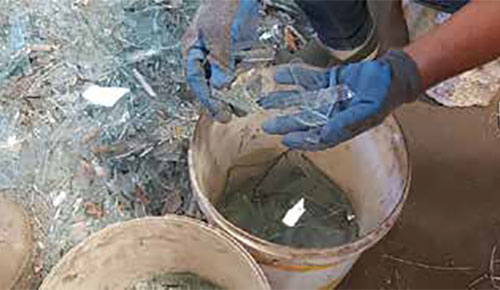
3- Four operators were hired at the factories in Beddaoui and they started inspecting and removing all debris and impurities from the incoming collected glass from Beirut. The first pickup truck was sent on 15 August and the last one on 27 November, capping a total collected weight of shattered glass of 124.97 tons.
The total cost of this project was LBP 20 million.
It is noteworthy that the operation would have collected much more glass but cleanup crews were collecting glass mixed with other debris in the same truck, rendering the glass recycling operation impossible.
The aim of this operation was to divert as much glass as possible from ending up in a landfill or as was the case, mixed with other rubble and unmanageable. Another aim was to provide our only two glass factories with free of charge raw material for their industrial production. In consequence, the added value was to incorporated both factories in the Green Glass Recycling Initiative for Lebanon (GGRIL), which has been in operation since 2013, producing beautiful and practical glass crafts.
The factories desperately needed to sell more goods to survive so we requested the production of a few designs that fit the GGRIL collection and since, we are working with them on a regular basis.
Evidently, the glass recycling effort caught the attention of practically all international news media, it was even reported in a newspaper in Tokyo. Major news outlets like the Agence France Press, Al Jazeera English, Deutsch Welle of Germany, France 24, Skynews Arabia, NEW TV, Al Ghad TV and many others have covered the effort in great detail.
Three days after the blast, a consortium of civil society consisting of Mouwaten Lebneneh, Baytna Baytak, Minteshreen and Embrace reached out to me to help devise a plan to clean up the areas of Gemmayzeh and Mar Mikhael. The plan consisted of collecting as much of the shattered glass and sending it to the Beddaoui area north of Tripoli where 2 industrial glass making factories are in operation (combined daily capacity 19,000 Kgs of glass) and to Sarafand glassblowers, which is an artisanal glassblowing workshop (daily capacity 150 Kgs of glass).
The first obstacles were financial; the combined group of NGO’s had enough money to cover the collection process from houses in the affected areas but no budget to cover the loading and transportation costs to the North and South facilities. I took it upon myself to secure the funding for that part of the operation.
The second obstacle was technical. Upon dispatching the rubble to the factories, the first loads of collected glass contained too much debris (gravel, wood and other impurities) and they pointed out that they could not introduce them as presented in their ovens. An inspection step was necessary to precede the feeding into the ovens. This step required two operators at each factory; hence, four workers to be remunerated monthly, a cost the factories were not able to incur at that moment. I told both factories to secure the workers and that I will find money to compensate the inspection costs.
Once the obstacles were surmounted by securing Bank Audi’s support, the plan evolved:
1- The civil society groups mentioned above with the help of volunteers secured three pickups to do the rounds over the totality of the affected areas, stretching from Beirut Port neighborhoods all the way up to Hazmieh. A whatsapp hotline was installed to which citizens were asked to send their locations so collection teams/trucks can collect the shattered glass.
2- I secured a bobcat and two pickup trucks to load the collected glass from the Mar Mikhael train station which was used as a glass storage space for the needs of this operation. All pickups where weighed using an electronic scale operator by Beirut Forum.
3- Four operators were hired at the factories in Beddaoui and they started inspecting and removing all debris and impurities from the incoming collected glass from Beirut. The first pickup truck was sent on 15 August and the last one on 27 November, capping a total collected weight of shattered glass of 124.97 tons.
The total cost of this project was LBP 20 million.
It is noteworthy that the operation would have collected much more glass but cleanup crews were collecting glass mixed with other debris in the same truck, rendering the glass recycling operation impossible.
The aim of this operation was to divert as much glass as possible from ending up in a landfill or as was the case, mixed with other rubble and unmanageable. Another aim was to provide our only two glass factories with free of charge raw material for their industrial production. In consequence, the added value was to incorporated both factories in the Green Glass Recycling Initiative for Lebanon (GGRIL), which has been in operation since 2013, producing beautiful and practical glass crafts.
The factories desperately needed to sell more goods to survive so we requested the production of a few designs that fit the GGRIL collection and since, we are working with them on a regular basis.
Evidently, the glass recycling effort caught the attention of practically all international news media, it was even reported in a newspaper in Tokyo. Major news outlets like the Agence France Press, Al Jazeera English, Deutsch Welle of Germany, France 24, Skynews Arabia, NEW TV, Al Ghad TV and many others have covered the effort in great detail.






The disclosed information is relevant for the period ending 2020
Download our app